Barzin Technologies, Inc.

Aerial robotics
that does the job.

Flight dynamics, control and flight software for unmanned aircraft — from no model to flight-validated closed loop.

Runs in your browser · keyboard or gamepad

Flight physics and controller behavior simplified.

NewOptimal Control Lab: design a course, watch the solver find the best flight →
Loading the airfield…
150+flight hours on one platform
600 kgcoaxial UAS, model to flight software
Sling loadexternal-load operations flown
R2025aour work ships in MathWorks examples

Flight test

150+ hours on one aircraft. Including sling load.

We built the complete guidance, navigation and control system for a 600 kg unmanned coaxial helicopter — and proved it in hours of real flight, in real weather.

Unmanned coaxial helicopter in closed-loop flight.Project at the Institute of Flight System Dynamics, TU Munich. Video used with permission of TUM-FSD and EDM Aerotec GmbH.
Flight testing the unmanned helicopter at the test field.Project at the Institute of Flight System Dynamics, TU Munich. Video used with permission of TUM-FSD and EDM Aerotec GmbH.
Automated maneuver injection for system identification, in a crewed light aircraft.Project with messWERK GmbH on their Remos GX aircraft.

What we do

From no model to flight-validated control.

Every identified parameter ships with an uncertainty bound.

Flight dynamics & identification

6-DOF models, maximum-likelihood identification from flight data, flight-test campaign design and envelope coverage.

Guidance & control

Trajectory optimisation, nonlinear control, state estimation, autopilots, gain scheduling and envelope protection.

Flight software

Production C++ for resource-constrained targets, allocation-free embedded code, hardware-in-the-loop verification.

Systems engineering

Requirements, flight control architecture, redundancy and failure-mode analysis (FHA, FMEA), actuation specification.

New · Optimal Control Lab Set up a course and watch our solver find the best possible flight, live. Open the lab →
In development · On-premise AI An AI model for flight dynamics and control, trained on public aerospace data, running on your own hardware: a Mac Studio or your own cloud account. Your data never leaves. Ask about early access →

The simulator

The pilot flies the real flight software.

Our engineering simulator runs the aircraft's own control laws — the same C++ that is compiled for the flight computer — against a model identified from flight data. Not a reimplementation: the code that flies.

  • 200 Hz real time on 0.4 % of one CPU core — 240× faster than real time
  • Validated against flight data, differentiable end to end: the model is identified from flight test, and the same C++ that runs the simulator gives exact derivatives through automatic differentiation, for linearisation, parameter estimation and optimal control
  • One core, two builds: native for hardware-in-the-loop, WebAssembly in the browser — they cannot drift apart
  • Real scenery of the test field from open elevation data, aerial photos and OpenStreetMap

The aircraft at the top of this page is a simplified public version with one easy control mode. The engineering simulator is available to partners — ask for a demo.

Hardware in the loop: flight computer, actuators and rotor head on the rig, the simulator on screen.Project at the Institute of Flight System Dynamics, TU Munich. Video used with permission of TUM-FSD and EDM Aerotec GmbH.

For airframe owners · FAA Part 108

You have the airframe.
We make it fly itself — safely.

A fully redundant flight control system for unmanned aircraft under Part 108: architecture, flight software, actuation and avionics integration. Designed around manned-aviation-grade hardware, and built to move to your aircraft.

Break it yourself. Click any box to fail it: computers, IMU chips, actuator lanes, buses, batteries, radios. Combine as many failures as you like; click again to repair.

Hover a component to see what failing it means.

How it stays safe

  • Fail-passive computers. Each flight control computer is dual-lane, command and monitor on dissimilar processors. On a miscompare it removes itself: it drops a hardwired healthy discrete and stops transmitting.
  • Fail-operational aircraft. Both computers fly at once, each driving its own lane in every actuator, kept in step over a dedicated cross-channel link. When one removes itself the actuators simply continue on the other lane: there is no switch-over.
  • No shared bus. Each computer owns its own bus into every actuator; each actuator has two lanes, electronics and motor winding, one per computer. No external voter.
  • Segregated power. Two essential buses on separate protected feeders, each with a buffer battery sized to carry the actuators through an engine-out descent and landing. The cross-tie is normally open.
  • Three IMUs per computer. Each computer votes its own dissimilar chips two-out-of-three, so the aircraft carries two independently validated attitude solutions.
  • Three independent C2 paths. Terrestrial, satellite and direct RC, on different bands, paths and transports. The lost-link procedure lives in the flight control computer.
  • Contained autonomy. The mission computer only proposes setpoints; a run-time assurance monitor in each flight control computer bounds them to the envelope.
  • Independent termination. Its own radio and power, independent of the computers and of every C2 link.
  • Partners from manned aviation. Flight-proven flight control computers from AEE and dual-channel actuators from Volz.

The demo is computed from our architecture model and classified against its functional hazard assessment. Where the model is silent it takes the conservative reading.

  1. 01

    Assess

    Your airframe, mission and weight class; architecture fit, FHA and the safety case.

  2. 02

    Model

    Flight test and system identification — a model of your aircraft with uncertainty bounds.

  3. 03

    Control & software

    Control laws, envelope protection and production flight software, verified in the loop.

  4. 04

    Integrate & fly

    Actuation and avionics integration, hardware-in-the-loop, and the flight-test campaign.

Publications
The methods, peer reviewed.

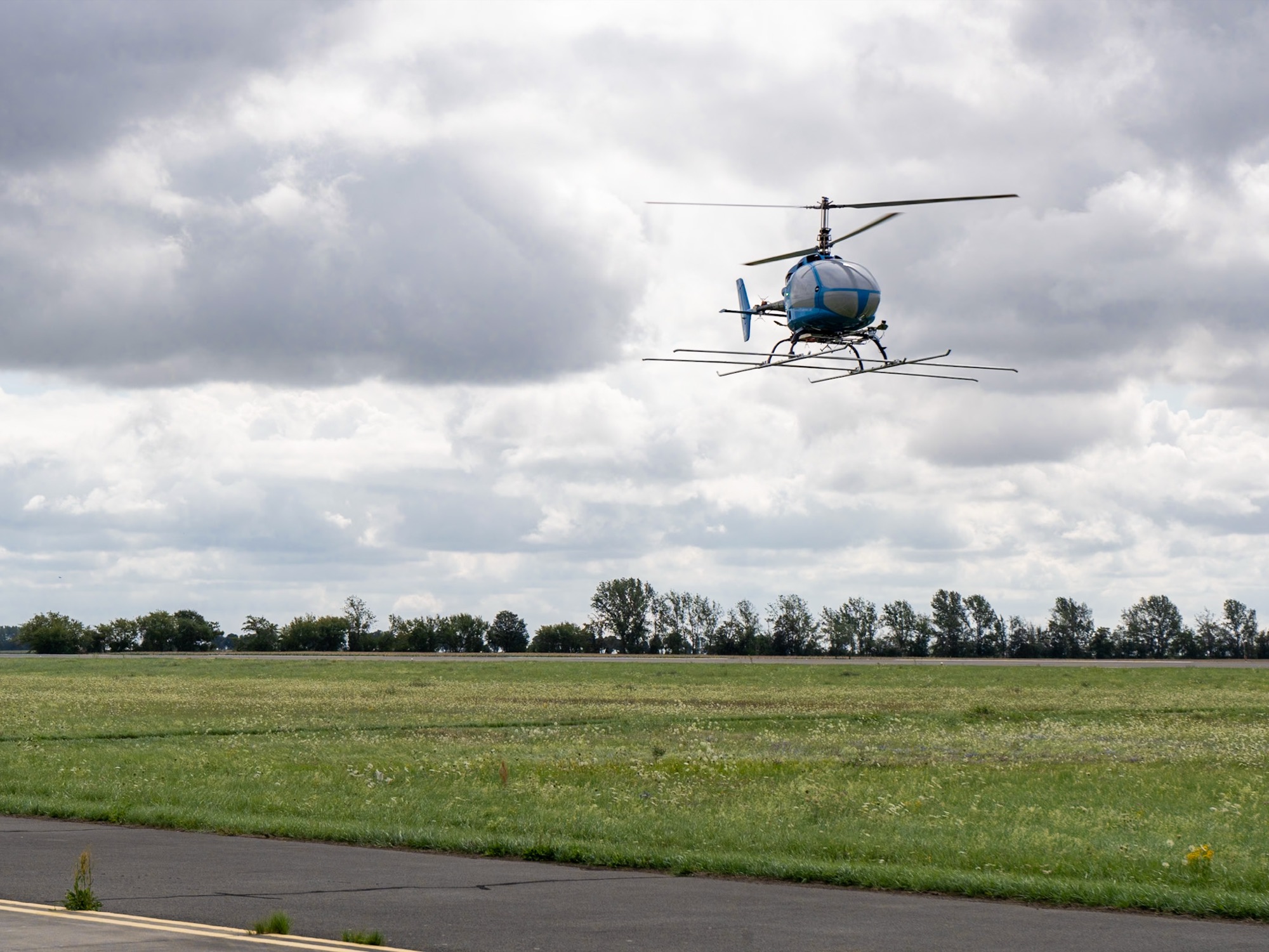
The unmanned coaxial helicopter hovering over the test field
Project at the Institute of Flight System Dynamics, TU Munich. Photo used with permission of TUM-FSD and EDM Aerotec GmbH.

About

Flight controls, from people who have flown them.

Barzin Technologies is a Texas-based company developing flight control systems and functions for unmanned aircraft. We take an airframe from no model to flight-validated closed-loop control.

Founder Dr.-Ing. Barzin Hosseini led the complete GNC system for a 600 kg unmanned coaxial helicopter — model, control laws and embedded software — which flew more than 150 hours, including external-load operations. We work with manned-aviation-grade suppliers of actuation and electronics to deliver complete flight control systems.

Some of this work was funded during the founder's PhD at the Technical University of Munich by the German LuFo programme (grants 20Y1705C and 20Q1719D).

Shop

We're baking something great for you.

Live soon.

Tell me when it's ready

Contact

Let's make your aircraft fly itself.

Airframe owners, OEMs and research partners: tell us about your aircraft and what it needs to do.

Dr.-Ing. Barzin Hosseini · Barzin Technologies, Inc. · Texas

We reply by email, usually within two working days.